
At the June meeting we had the pleasure of welcoming Simon Temblett, an artist and grower with decades of experience, curiosity, and a refreshingly experimental approach to bonsai.
He began by sharing a story on the humble origin of a blue Atlantic cedar grown from one of hundreds of seeds collected during a brutally cold winter in the early 1980s. It was a story of serendipity, enthusiasm, and more seedlings than he knew what to do with!
Walking past a tree near where he was working at the time, he discovered that several cones had germinated whilst still attached to the the tree. He collected several hundered of them and planted them up.
Over time, many of the seedling and trees grown from them were given away, a few were grown on in a field and forgotten about for many years. One in particular, originally deemed too straight and awkward for bonsai, became the subject of a long-term experiment in styling and artistic transformation.
With it’s unsuitability for bonsai and having nothing to lose the tree was created from one of several air layers that were taken from the trunks of the cedars that had grown on in that field.
A particularly striking feature of this tree was ivy climbing up the trunk, rarely seen in bonsai. As he explained, the ivy started off as a chance seedling that came up in the pot. This not only complemented the tree visually but also served to obscure wire scars and add more visual appeal to the bark, which can take a particularly long time to show signs of age on cedars.
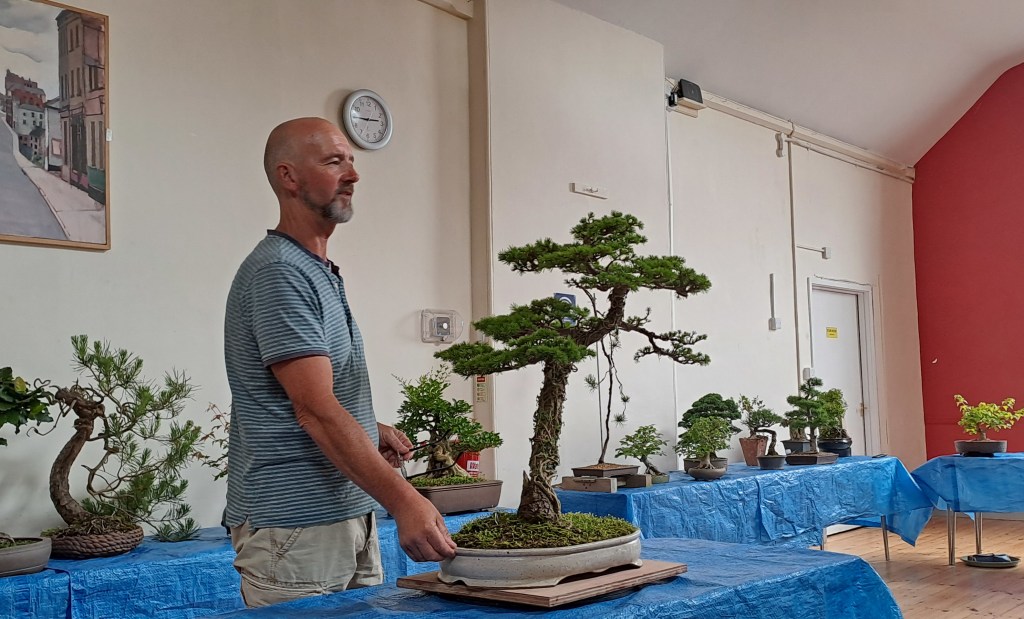
The history of a number of other interesting trees and techniques were spoken about including:
- A privet that had deadwood sculpted into the shape of a human form inspired by fire-blackened trees in the Australian bush
- Experimenting with embedding polished stones into tree bark, allowing it to grow around them naturally (when the magpies don’t try to take them!)
- Carving “tattoos” into the surface bark to evoke Māori or Aboriginal motifs
- A very unusual Japanese maple styled as a “root over pot” which provides some interesting watering challenges
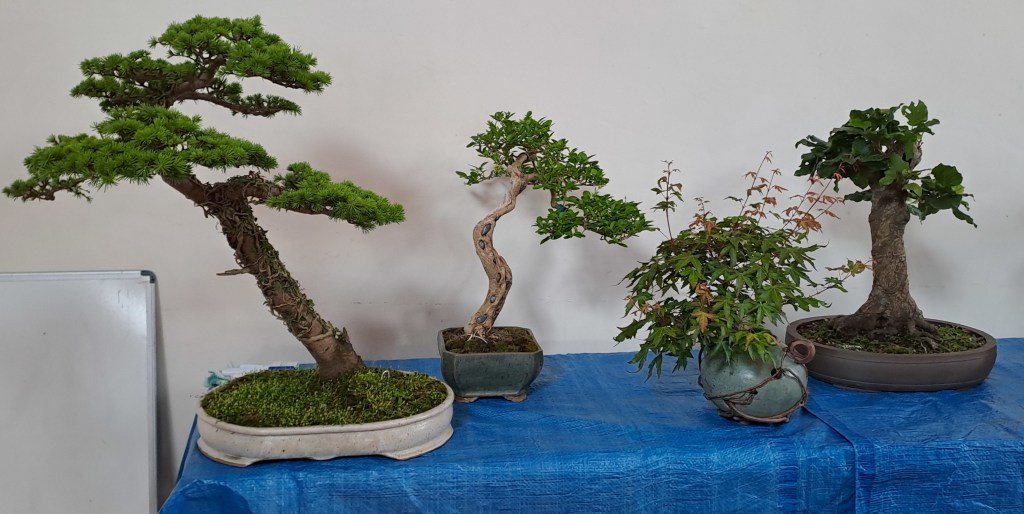
He spoke about how a tree is never really “finished” and how not every experiment is successful. The pot also plays a key role in the composition and should complement the tree, he invited us to suggest and discuss ideas for more suitable pots for his trees. Many of his pots are self-made, created through trial and error until the right form emerges to support the tree’s character. And when a tree dies? He doesn’t necessarily throw it away. Instead, it can become a sculptural relic—a lasting reminder of its own journey and the hands that shaped it.
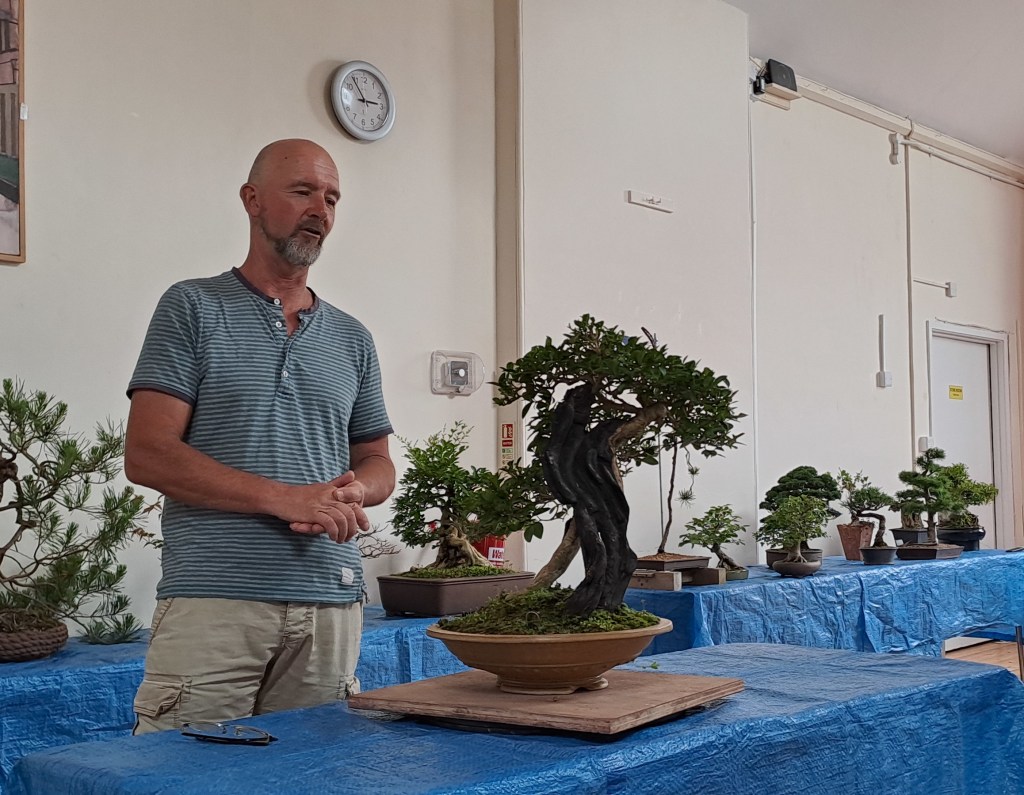
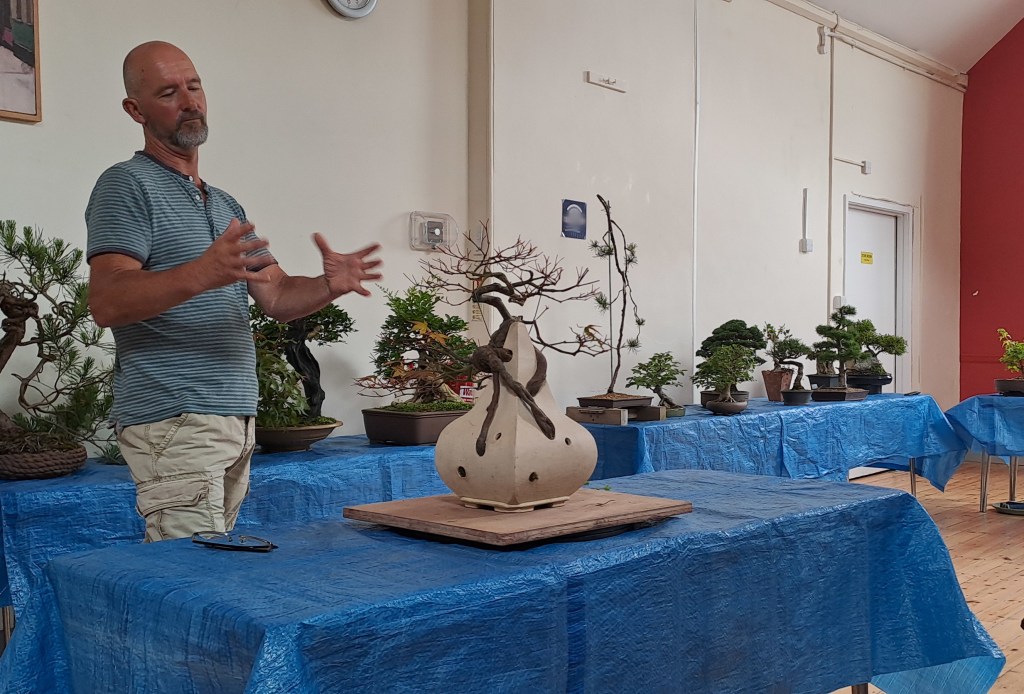
For those of us in the club, it was a refreshing reminder that bonsai is not just about technique—it’s about play, patience, and persistence. Whether you’re wiring your first branch or refining a tree you’ve had for 20 years, there’s always something more to learn, and something unexpected waiting to emerge.
Many thanks to Simon for his inspiring talk.
 Exeter Bonsai Society
Sorry to miss that; my favourite tree at school was the glaucous atlantic cedar I had to pass every time I went to the food hall. I’ll try to come at the end of July, with my Juniper from Exmouth for a bit more advice
Chris Brown
ph UK, Europe, WhatsApp: +44 7533 817482
LikeLike