
Neil Hutchings gave a talk at the September meeting on using Mediterranean tree species as bonsai. He went into detail on the primary Mediterranean species used for bonsai: oaks, olives and mock olives. He also gave examples of how he has developed bonsai from all of these species and useful tips on growing and maintaining them.
Mediterranean Oaks (Quercus spp.)
The genus Quercus comprises around 750 species worldwide, with several native to the Mediterranean basin. Three species that are particularly well suited to bonsai are Quercus suber (Cork Oak), Quercus faginea (Portuguese Oak), and Quercus ilex (Holm Oak).
Cork Oak (Quercus suber)
An evergreen oak that can produce 3–4 flushes of growth per season. Their distinctive corky bark develops after approximately 10 years, the same bark is used for wine corks and tiles.
Holm Oak (Quercus ilex)
The Holm Oak was introduced into Britain from the Mediterranean in the 1500s and is also evergreen like the Cork Oak. It has small leathery leaves resembling holly which is why it is also known as the “Holly Oak”. This tree loves warmth and sunlight and should be kept on the dry side in winter.
Portuguese Oak (Quercus faginea)
This Oak species is deciduous, native to Iberia and North Africa. It is a much faster species to develop as a bonsai compared to the native English Oak (Quercus Robur) and it has smaller leaves and produces finer ramification.
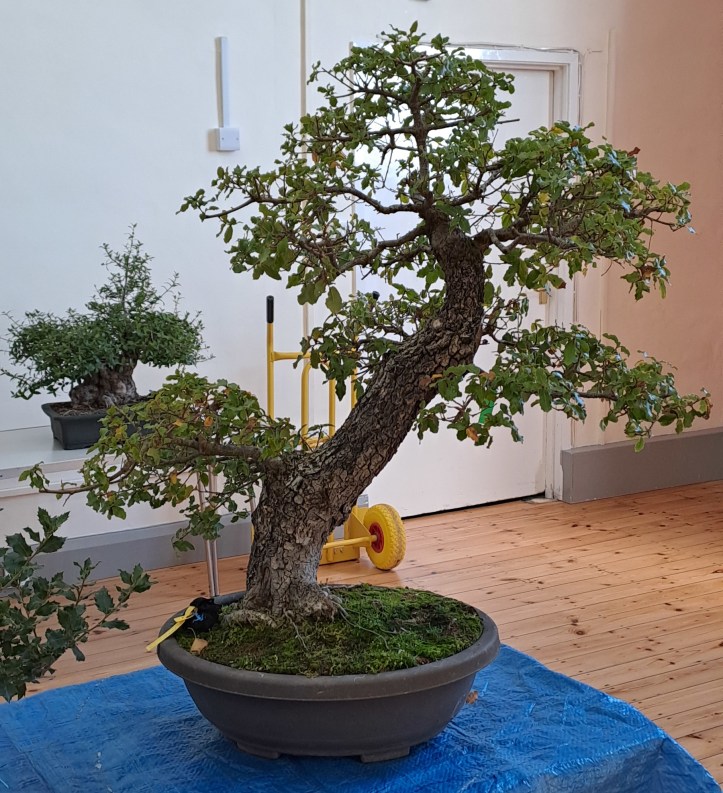
Oak growth characteristics
Like the native English Oak, deciduous Mediterranean oaks produce their first leaves of the season in late Spring (mid to late May). Pruning should be carried out after the leaves have hardened off as with other deciduous species.
Mock Olive / Privet (Phillyrea spp.)
The Phillyrea genus (family Oleaceae) includes evergreen shrubs and small trees closely related to olives and privets. Two species, P. latifolia and P. angustifolia (narrow leaf), are native to the Mediterranean. They respond well to hard pruning, reliably back-budding from old wood. They are sometimes overlooked as a species for bonsai but can make a more robust alternative to Box which can be affected by box blight.
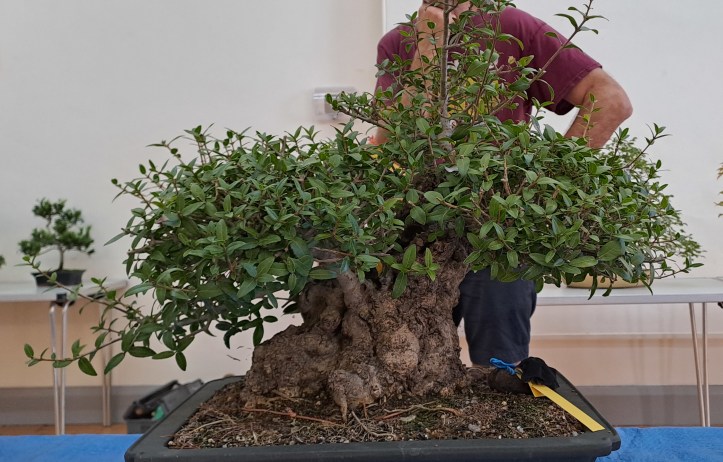
Olive and Wild Olive (Olea spp.)
The olive genus (Olea) contains many taxa, but for bonsai, two are relevant:
- Olea europaea (cultivated olive)
- Olea europaea silvestris, subsp. oleaster (wild olive, or oleaster)
The Wild Olive has smaller leaves, shorter internodes, and denser branching than cultivated varieties making them more suitable for bonsai.
Olives are hungry trees so should be fed regularly during the growing season, roughly every 6 weeks with slow release fertiliser.
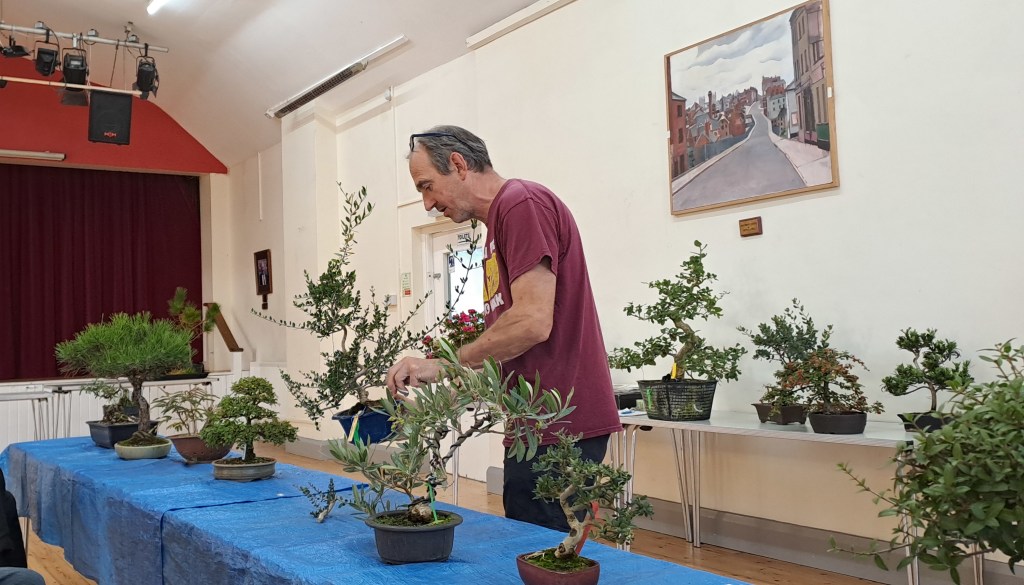
General cultural principles for Mediterranean species
Re-potting
Unlike temperate species that prefer to be re-potted in early spring, Mediterranean trees respond best to mid-summer re-potting (June–July) when the day length and light intensity are maximal. Complete defoliation at re-potting time is advantageous as they respond better. Although counter intuitive they can be placed immediately back into full sun — unlike many temperate species, Mediterranean species respond positively to high light intensity and heat after re-potting. The various Quercus species are sensitive to root work, so don’t remove too much during a repot.
Winter care
Most species tolerate –5 °C if kept dry. Cold frames or poly-tunnels provide adequate winter protection. They should be kept relatively dry during winter. Neil mentioned how having a young weed in the pot can be useful indicator for determining when to water during this season as they will start to droop just before the tree needs watering.
Propagation
Growing from seed is probably the best method for oaks, although there can be large variations in the seedlings. Olives are easiest to propagate from cuttings.
Many thanks to Neil for the detailed and entertaining talk.
 Exeter Bonsai Society